10 Most Compelling Recruitment Advertisements

Employers release recruitment ads to attract the best professionals for their organization. You probably see at least one job vacancy ad in a day, in newspapers and on the television or while browsing social media and public boards. Unless you are a job seeker, you tend to ignore the ads cause they are uninteresting. However, there are recruitment ads that capture your attention with their creative spin and innovative imagery. 
The following ads are the highlights of a collection of ads used to quickly fill positions. 


1. "OLD RECORD" Print Ad
Tagline: Looking for a new job? Get your own personal job agent at jobzonen.dk
The ad is simple, clearly expressing the role and services of the online job search site. Done by Hjaltelin agency of Denmark, It displays the reason why someone would want to quit their job and offers the site as a reprieve for the tired worker. A co-worker speaking like an old record (meaning repeating old stories), next to an apt image of a sleeping dog for further effect, annoys the woman enough that she thinks of the job search site. The ad commiserates and identifies with the audience in a very unique and straight-forward manner.


2. Tonic Communications recruitment ad
Tagline: Hungry designers wanted
A parody of the famous apple logo that is associated with design ingenuity and loved by designers. The ad, designed by Tonic Communications is attractive in its simplicity, delivering a strong secondary message. Clearly understood is that the company is looking for an innovative designer capable of imaginative thinking and explorative thought. In this case, the image is enhanced by the copy.


3. Trade Me Jobs: Smile
Tagline: Seriously big dough is here. Our new Six-figure jobs section has over 1,200 jobs offering $100k+
A funny ad that plays on the slang word of dough, referring to money. The display of the money shaped dough on a pan is a quirky way to attract views to the tagline and the company. Instead of going for bright, bold prints, the simple idea is enough to make a statement.


4. Serviceplan Recruitment: Organ donation, Heart
This vivid illustration of the skinless person is attention-grabbing, only by reading the copy does the viewer gets clarity on the company’s motives. Serviceplan, located in Germany, wanted to hire innovative professionals to their offices. With the use of audacious imagery complemented by a clever copy, they invited graphic design and advertising students to join their ranks. Asking them to “donate” their brains, hearts and eyes towards building a strong advertising company. On the surface, viewers think they know what the ad is about, on further scrutiny, something entirely different is revealed which is a very good twist.


5. Brandford Sub Aqua Advertisement
The man represents the dedication and fervor required to work in the BSA Company, calling for people with a similar mind and skill set. BSA intended to recruit people in the local community where diving was a favorite pastime so they incorporated it into their campaign. Buzz created by the campaign among the public would encourage interest and applications. This simple creation speaks to local people and used inexpensive means to deliver the company’s message. To keep costs low, the image was bought from istock and manipulated in photoshop for the final poster. It stands out for the strong influence it exerts on lookers.


6. PNet: Dictator
Tagline: Tired of office politics.Get a better job on PNet.co.za and make change happen.
The advert earns viewers confidence with strong graphics and a provoking message carrying a hint of irony. Formal colors increase the seriousness of the appearance and exude the strength for the individual to search for a new job instead of tolerating the implied injustice.


7. Career Junction: Grocery list
Tagline: Put your skills to better use.
Simple concept that communicates well the purpose of the online job site; to ensure that people find their dream job with their matching skill set rather than wasting their talents. The site projects itself as the best job site and most capable for identifying talent and enabling growth with the right job position. Many lookers love the elaborate typography on the notepad, artistic and representing the job seeker's talents.


8. thebigchair.com.au: Chair
Tagline: Where the big jobs are.
What a creative way to showcase the logo of the online job site and encourage people to think about it. No overstated graphics or colorful images, just a gorgeous art direction that imprints the brand into the mind of the consumer. This shows that not every ad has to have a witty visual aid to get the brand message across. Arranging the copy in the structure of a chair attracts attention to the sentences, which have been carefully selected to draw job seekers to the site. Many viewers are divided about the repetition of sentences in the copy; some say it is a poor decision while others think it makes the copy more persuasive.


9. CareerBuilder.com: hot water
Tagline: Maybe it’s time to move on.
Amazingly the ad uses clever camera angles and innocent objects to depict a state of mind and show real emotions. By looking at the ad, we can imagine ourselves in a similar situation of “being in hot water” and harboring feelings of anxiety and distress in our workplace. A solution is the CareerBuilder.com, the ad touts the site as a good start for people in dire need of a job change to escape their troubles.


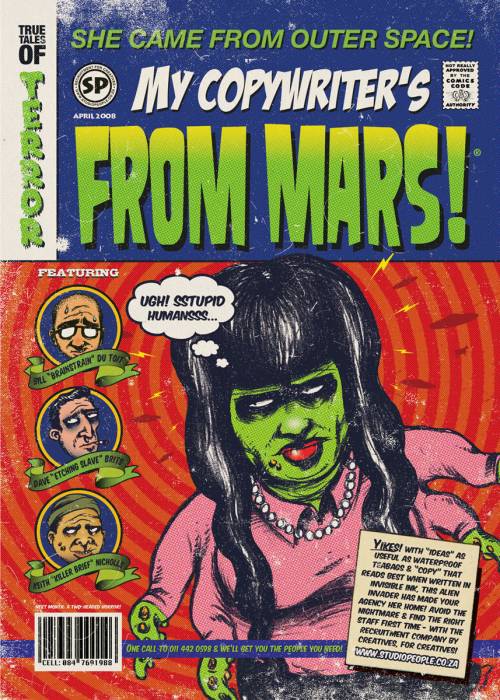
10. Studio People: Copywriter
Tagline: Copywriter’s from Mars! Yikes!
Finding the most imaginative people is shown to be easy with an innovative idea and a humorous copy. Creating an ad with the imaginative twist on the usual comic book theme is a very good idea to recruit creative professionals to the company. It has strong appeal among the artistic minds.
Designed in the style of old comics, every aspect has been constructed to resemble the genuine product from the bar code to the blue ribbon. Even the placement of the copy and its font is cohesive to the general theme of the recruitment advertisement.

Via Ad Punch.

Ad World Funnies


18 Creative and Clever Billboards

Use Electricity Wisely - Eskron

Sleep with your wife - IndiGo

Drills through anything....

Ponds -cleans pores, fights pimples

Koleston Naturals

Seat Belts Save

Decorate for the holidays- IKEA

Imodium wash

Durex Performa - Durex Performa

The Back Seat is no safer. Belt up. 

Tailgating isn't worth it

Sugar free - Low calorie sweetner

Ariel - Spotless. Clean.

Berger - natural Finish Colours

FedEx 

The sky has never been cheaper.
Formula. Builds Stronger Teeth

MSN search on your Hutch phone


Dubious HR Profiles & Unrealistic Job Offers At Companies That Don't Exist. Welcome to 2012 Social Media Scams (LinkedIn)

As scary as this sounds, the number of fake profiles on professional sites like LinkedIn are on the rise. Every single day thousands of guileless and gullible job seekers are establishing connections with fake HR profiles and sharing their CV's and other personal details in the hope of finding that dream job. Well, what most of them don't know is that in the process they are falling victim to the clever machinations of unscrupulous elements who steal all their personal details for database and other misuse.

Its been a month since I started this Social Media campaign (read crusade) against fake profiles on LinkedIn (Click here for more info) and since then, I've written to thousands of people across LinkedIn, Facebook and Twitter about the dangers of connecting with fake HR's and how to detect fake profiles on LinkedIn. Renowned Social Media Blogger & Author Cendrine Marrouat who realized the implications of this new scamming practice put out a lovely blog with illustrations from my Facebook Page to show people how to distinguish between a fake profile and a real one. 


Dubai based writer Samer Batter published a lovely write-up in two of Middle East's top news portals Al Jazeera and Arabian Business. Mahsoom Thottathil and Moign Kwaja published my interview on Arabian Gazette, My sincere thanks to all of them. 

I thought a blog is the need of the hour coupled with effective campaigns across Facebook, Twitter and LinkedIn to make everyone aware of the scams and how to deal with fake personalities on sites like Linkedin. I highlight several key issues here in this blog, with real examples of people who tried connecting with me on LinkedIn in the recent past.


Introduction


LinkedIn is a professional network that claims they have over 150 million professional’s profiles online.  We are not sure how many of those 150 million profiles are probably ‘bots’, fake profiles created by unscrupulous people for nefarious purposes.   Let’s look at why such fake profiles exist, what are the signs of such fake profiles, and how you can spot such fakes online. Hopefully, you will check your own profile to make sure it doesn't look fake. While this article is written primarily for LinkedIn, most of the tips can be applied to other social networks as well.

Why have a fake profile on LinkedIn?


There are many reasons on why people create fake profiles or include fake references, and these are just some examples (not in any particular order): 
  • To disguise true identity (ex: a person well known for leading people into "opportunities" may not wish to reveal his or her real name to prospects)
  • To gather e-mail addresses for spam lists
  • To present a more enticing image (ex: male marketers may instead present a female profile as his "public image". In fact, it is learnt that most fake profiles are female)
  • To create an artificial image of popularity in hopes of starting a viral trend
  • To gather up connections later to be sold for profit (ex: supposedly a person on LinkedIn offered his connections for money)
  • To appear more legitimate or more qualified than reality (ex: by claiming alumni at a famous university, or at a Fortune 500 firm, s/he may be able to connect with someone that would not have otherwise accepted the connection
  • To denounce / insult / troll / attack a rival company, often pretending to be a whistleblower (i.e. an employee)
  • To give the image of a bigger company than it is, by having several "fake staff" at a one-person company join the company
  • To impersonate employee of a rival company and issue public insults in their name


Why LinkedIn in particular?            


LinkedIn claims to be a social network for "professionals". LinkedIn is definitely more professional and less spamy than other social networks. It does this by limiting connections to people you know / connect through professional or educational links (alumni, work, interests, etc.)  However there seems to be no mechanism on LinkedIn to verify any of the qualifications, associations, education, or employment history. This had lead to abuse by unscrupulous people.  It is purely up to the individual members to use their good judgment and  check up on whoever is attempting a connection.
For instance if the CFO of Bank of America wants to connect with me, then I surely need to relook the profile and see what is amiss. Using a simple google trick as illustrated on this page one can check if a profile is legit or no. Google simple reveals all the places where the image has appeared online and by this one can easily detect where the image has been grabbed from. 

What can you do about fake profiles?


LinkedIn has this "flag" function for profiles. If you think the profile is very obviously fake, please use the flag button. However, keep in mind that abuse of flag button may cause your own profile to be flagged. LinkedIn are serious about finding abusers of their system and we must support them in removing the troublemakers by carefully looking through profiles of those who wants to "connect" with you, and see if there are fakes in the mix


What are signs of a fake profile?


The signs of fake profiles are varied, most of which would be basically stuff that does NOT make sense... if you look a little closer.


The signs generally fall into the following categories


  • Name Problems
  • Picture Problems
  • Education Problems
  • Employment Problems


Please note that the signs individually do not indicate a fake profile, but multiple signs within a single profile vastly increase the chances of the profile being fake.

1. Name Problems


Name problems are within the name of the profile itself.

Generic name like Steward Williams 


Lower case first and last name


Rhythmic names like Sam Smith, Joe Johnson, Shane Lee etc sounding straight out of a Novel or Movie. Basically, if the name looks like one of those "from" names you find in spam e-mail, it's suspicious.


Clearly Implausible names like Jovito Estera for a female (which is clearly obviously an eastern male name) 


Strange Sounding company names like this one "bei MaE Service Agency"


Badly capitalized names (all lower case, or ALL CAPS, or just bad caps). People who can't spell their own names or capitalize their own names right are probably bots. At the minimum they are unprofessional.


    2. Photo Problems


    Photo problems are with the suspect profile photo itself. The fake profile photos can be from many different places. Initially people just copied photos of famous celebrities. Later they started to copy photos of CEOs, and even stock photos (such as Getty Images / iStockPhoto). Recently the picture thefts have gone international, with pictures being lifted from blogs in Asia, stars reports in Middle East, Flickr from all over, and so on. By a simple google test, which I have illustrated on my Facebook page, (dragging an image and dropping it onto the google images search box) - one can find the source of the image and similar images on the internet. This may lead you to the legit profile in most cases. You can also use TinEye.com which helps you find  an image was lifted from.


    Fake profile photos generally have one or more of the following characteristics:

    • Photos that seem to be way too professional... or UN-professional
    • Photos that are too "posed" are clearly suspect. 
    • Obvious Stock Photo
    • Clearly implausible photo
    • Obvious Star Photo (Many fake profiles used movie stars, TV stars, sports stars, and more recently dead Sheikhs of UAE, and other royalty from princely families)
    • Obviously wrong gender
    • No photo at all (If they don't want to show their face, you probably don't want to connect with them)


    3. Education Problems


    Fake profiles often have problem with listing about their education. Very often, fake profiles do not list any. If they do list some, it is often a fake listing

    Here are some of the signs of a fake education:


    • Education at a Generic Name Universities or Colleges (ex: Art Center College of Design)
    • Education at prestigious Universities or Colleges that cannot be verified through alumni records, or through any sort of alternate references (yearbook, fraternity or sonority, etc.)
    • No major or specialization listed
    • No time listed for college attendance
    •  Education timeline does not add up
    • No education listed at all


    4. Employment Problems


    Fake Profiles on LinkedIn, often have fake references as anybody can claim to have worked for any company, even if that company has a presence on LinkedIn itself. Most fakers are not that bold though. They will simply make up a name for their alleged place of employment.


    Here are the signs of fake employment history:


    • No employment history (just a "current job")
    • Employment timeline that does not add up
    • Employment at obviously fake company ex Vaneffen Consults. There is no such company and the lady’s image is from iStock Photos.
    • Employment at Generic Name companies
    • Employment at prestigious companies that cannot be verified through human resources or any sort of third-party sources (company website, published articles, company newsletters and/or recognitions, and so on).
    • Employment at nowhere in particular (i.e. no company specified). If they are currently unemployed, then they should just say so. 


    Suspect Fake Profile Analysis


    What's wrong with this profile?
    1. Unprofessional Photo ( The Google search led me to hot blogs in Pakistan)
    2. Education not listed
    3. Details of past employment not mentioned
    4. No description of job responsibilities
        5. No links to website, blog or twitter
        6. No recommendations (LinkedIn requires that you at least have 3 recommendations)
        7. No other information whatsoever, other than the person’s name and company name.

    Key Differences Between Real and Fake Profile


    Fake Profile : Contradictions


    The Technique of Spotting a Fake Profile on LinkedIn


    How to Find a Job Using Social Media

    Looking for a new job can be overwhelming sometimes, especially if you’ve been on the prowl for a while. While 20% of American adults are still shy about the internet, the other 80% – including most companies looking to hire – have found the Web to be a great resource for job seeking and finding. Most of us know how to use the big social media networks to interact socially – but why not use them to find a new job? Here are some ways you can you exploit Facebook, Twitter and LinkedIn to look for a new, exciting career:

    1. Let Facebook do the Work


    18,400,000 Americans found their job on Facebook in 2011 – More than Twitter and LinkedIn combined.  Most of us enjoy Facebook as a social platform, but the largest social media site on Earth can also be used for more practical purposes. How can you use Facebook to your advantage? Here are some simple ways to get started, and you can also read an in-depth analysis of them right here.

    First of all, let your friends and former colleagues know that you’re looking: update your status with the specific position/s you’re looking for, and ask them whether they’ve heard of any relevant hiring. Keep updating that job-related status every once in a while to let them know you’re still looking.
    Join a professional community, and “Like” potential employers’ pages. These pages can be a great way to gain new friends who can help you professionally. You can be an active member of a Facebook interest group by starting discussions, posting links and in general – letting people know about you and your field of expertise.

    Use Facebook Applications:  Branchout, the largest professional networking service on Facebook, allows you to search for positions and find out which of your friends are connected to the companies you’re interested in. SimplyHired aggregates job listings from thousands of sites across the ‘eb including job boards, newspaper, classified listings and more, and recommends jobs based upon your previous job titles and Facebook interests. BeKnown, an app launched in June 2011, acts as a sort of LinkedIn within the social network, letting Facebook users separate social activity from job-related activity without leaving Facebook. Facebook’s Marketplace has a Jobs section, where you can search for work by filtering location, keyword, job title, industry, company and type of position.

    2.  Tweet for a new job

    Unlike Facebook, Twitter allows you to connect to people according to common interests. Landing a job using Twitter can be done by following several steps, besides tweeting intelligently on the field in which you’re looking to get hired: Look for job listings under hashtags like #jobs, #recruiting, #jobadvice, #jobposting to name a few. Find out who currently works in the companies you want to work for. Create a network of people with like-minded professions. You can use Twellow in order to find people by area of expertise or profession. 

    3. Be on LinkedIn
    The “Facebook for job-hunting” now boasts of over 150 million members, making it the largest business-related social networking site in the world.  Millions of Americans found a job using LinkedIn, using direct contacts or second or third degree connections.

    There are abundant Job-related features on LinkedIn: you can review profiles of hiring managers and see which of your existing contacts can hook you up with a useful introduction, get notifications about available offers, bookmark jobs for which you’d like to apply,  use the “Apply with LinkedIn” button with companies that offer them, and much, much more.


    Article Courtesy WIX.com